
%20(14).jpg)
For nearly 25 years, the American Transportation Research Institute has analyzed truck GPS data to measure freight mobility across the United States. Its annual Top 100 Truck Bottlenecks report has become one of the most important indicators of systemic highway congestion and its impact on supply chain performance.
The 2026 findings reinforce a hard truth for supply chain leaders:
Highway congestion remains one of the most persistent structural risks in freight transportation.
And while many organizations focus on optimizing over-the-road strategies, the execution layer closest to these chokepoints, the yard, is often overlooked.
Let’s break down the key findings and what they signal for enterprise operators.
By the Numbers: National Freight Congestion Snapshot
According to ATRI’s 2026 analysis:
- 325+ freight-significant locations were analyzed using truck GPS data
- 100 top bottlenecks identified nationwide
- Average peak hour truck speed: 33.2 mph
- 75 percent of the Top 100 locations have average truck speeds below 45 mph
- Peak speeds at bottlenecks declined 2.8 percent year-over-year
- 28 states have at least one Top 100 bottleneck
These figures underscore the scale of the issue. When trucks are averaging 33.2 mph during peak hours at critical freight nodes, delays are not isolated incidents. They are structural constraints embedded in the network.
The Top Congestion Hotspots in 2026
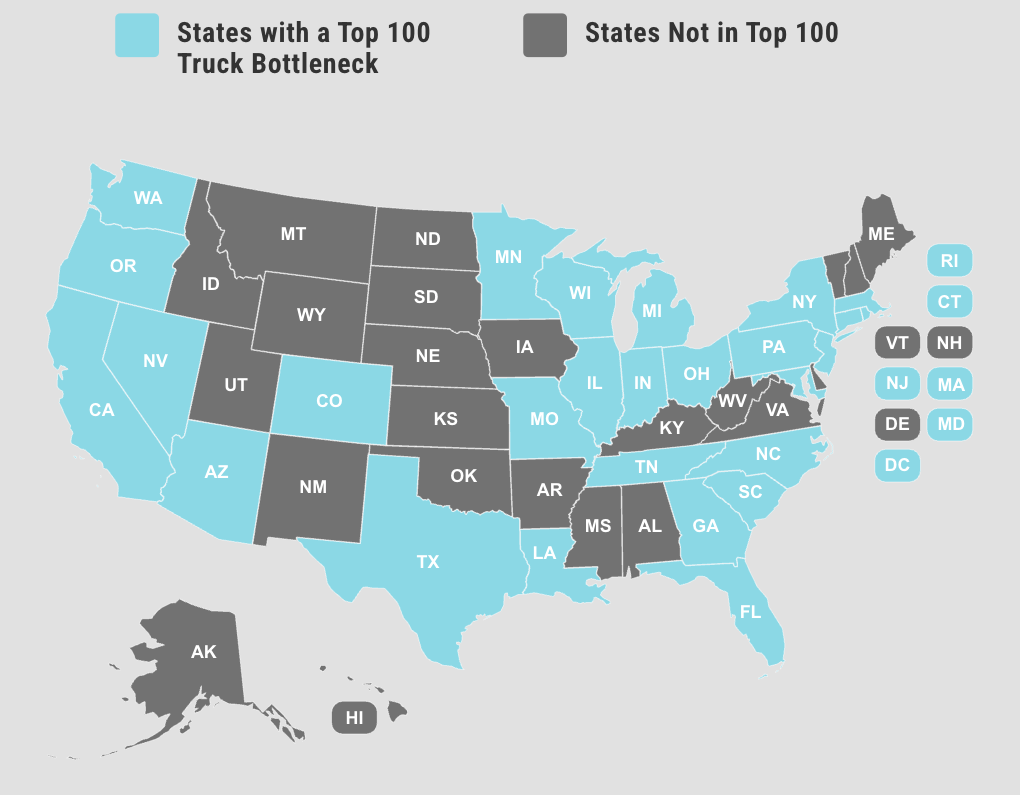 Source: American Transportation Research Institute
The highest-ranked bottlenecks this year include:
- Chicago, IL – I-294 at I-290/I-88
- Fort Lee, NJ – I-95 at SR 4
- Atlanta, GA – I-285 at I-85 (North)
- Houston, TX – I-45 at I-69/US 59
- Atlanta, GA – I-75 at I-285 (North)
- Atlanta, GA – I-20 at I-285 (West)
- Nashville, TN – I-24/I-40 at I-440 (East)
- Houston, TX – I-10 at I-69/US 59
- Cincinnati, OH – I-71 at I-75
- McDonough, GA – I-75
Notably:
- Texas leads with 12 bottlenecks
- Georgia follows with 9
- California and Tennessee each have 8
- Illinois has 6
These are not random corridors. They are high-density freight hubs connected to major ports, distribution centers, manufacturing clusters, and retail networks.
For enterprise shippers operating multi-site networks, these chokepoints are daily operational variables, not theoretical risks.
What This Really Signals
ATRI’s methodology synthesizes massive truck GPS datasets with speed and volume algorithms to quantify congestion impacts at freight-significant locations.
The takeaway is not just that congestion exists.
It is that congestion is measurable, persistent, and geographically concentrated.
That concentration creates:
- Increased variability in arrival and departure times
- Higher detention and dwell exposure
- Driver productivity loss
- Fuel consumption and emissions increase
- Escalating transportation costs
- Service instability across networks
Highway congestion amplifies every upstream and downstream execution weakness.
Which leads to the critical question.
If the road network is constrained, how resilient is your execution layer once freight reaches the gate?
The Yard as a Congestion Shock Absorber
When trucks move at 33 mph through peak freight corridors, yards become pressure points.
- Late arrivals compress dock schedules
- Gate queues extend
- Move plans collapse into reactive labor adds
- Throughput variability increases
In many networks, yard operations were never engineered to absorb external volatility at this scale.
This is where enterprise discipline matters.
ATRI’s data shows congestion patterns that are unlikely to disappear overnight. Infrastructure investment takes time. Legislative reauthorization cycles are long. Freight demand remains strong.
Shippers cannot wait for highways to fix themselves. They must build operational control closer to home.
Strategic Implications for 2026 and Beyond
For supply chain and logistics executives, the implications are clear:
- Congestion is a structural input, not a temporary disruption
- Network planning must account for persistent chokepoints
- Site-level variability compounds enterprise risk
- Execution discipline must extend beyond transportation and warehousing
The yard is the interface between highway volatility and facility performance.
If it operates reactively, congestion multiplies cost and service instability.
If it operates under governance, standardization, and engineered throughput models, it becomes a buffer and control point.
From Bottlenecks to Control
ATRI’s 2026 Top Truck Bottlenecks report does not rank intersections alone.
It provides a roadmap for where freight friction is concentrated across the United States.
Enterprise shippers that treat these findings as a transportation-only issue are missing the broader execution story.
Congestion is a given. Variability is measurable. Network pressure is persistent.
The differentiator is not whether congestion exists.
The differentiator is how well your operating model absorbs it.
In 2026, resilience will not come from adding more tools. It will come from effective governance at every layer of the network, including yard operations. And in an environment where freight mobility averages 33.2 mph at peak choke points, that discipline is no longer optional.
%20(6).png)
%20(20).png)