
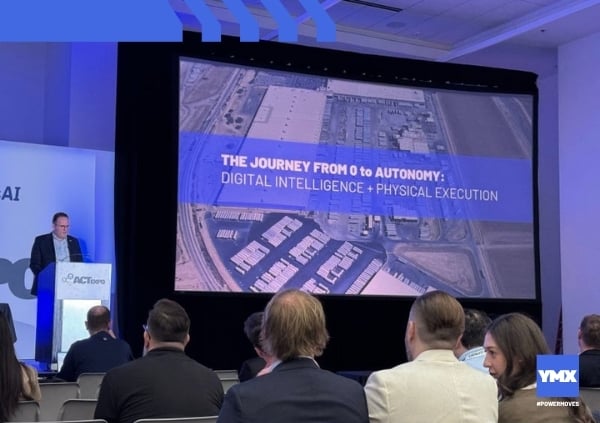
Autonomy dominated the conversation at ACT Expo 2026. Autonomous yard trucks, artificial intelligence, robotics, digital twins, computer vision, and automated workflows were everywhere. The technologies are advancing rapidly, investment continues to accelerate, and the potential impact on supply chain operations is undeniable.
Yet amid all the excitement surrounding automation, one message stood out.
"You can't coordinate what you don't know."
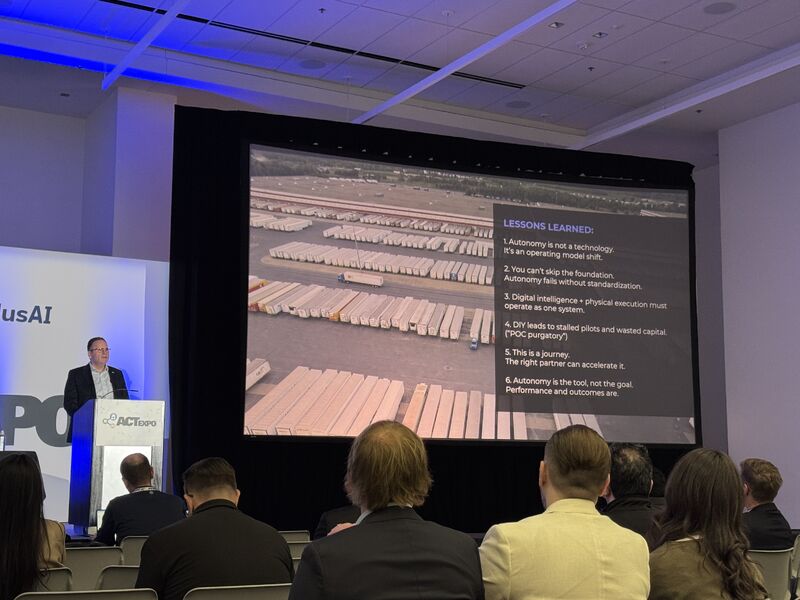
During his ACT Expo presentation, The Journey From Zero to Autonomy: Digital Intelligence + Physical Execution, YMX Logistics CEO Matt Yearling challenged one of the most common assumptions driving automation initiatives today. While much of the industry remains focused on the technologies themselves, the larger challenge often lies within the operation. Across transportation, warehousing, manufacturing, and distribution networks, organizations are investing heavily in artificial intelligence, automation platforms, sensors, autonomous equipment, and advanced analytics. At the same time, many continue to struggle with fragmented workflows, inconsistent operating procedures, disconnected systems, and limited visibility into how work actually gets done.
This disconnect is creating what may be one of the most significant barriers to automation success across the supply chain: an automation readiness gap. Technology is advancing faster than operational maturity.
Too often, autonomy is approached as a technology procurement exercise. Organizations evaluate software platforms, autonomous vehicles, cameras, sensors, and AI applications before fully understanding the operational challenges they are attempting to solve. The reality is that autonomy is not a product that can be purchased and deployed. It is the outcome of a well-designed operating model. Technology plays an important role, but it cannot compensate for inconsistent processes, fragmented execution, poor data quality, or a lack of operational discipline. The organizations creating the most value from automation are not necessarily deploying the most technology. They are building the strongest operational foundations.
You Cannot Skip the Foundation
One of the most common mistakes organizations make is attempting to accelerate directly toward automation without first establishing the conditions required for automation to succeed. Autonomous operations depend on predictability. Processes must be repeatable, workflows must be understood, data must be reliable, and performance must be measurable. Without those elements, automation often magnifies existing inefficiencies rather than eliminating them.
This challenge extends far beyond yard operations. Across the broader supply chain, organizations continue searching for ways to automate transportation planning, warehouse execution, inventory management, labor allocation, and manufacturing processes. Yet the same pattern repeatedly emerges. Companies attempt to automate complexity before they fully understand it.
The yard often provides a clear example of this dynamic because it sits at the intersection of transportation, warehousing, labor, equipment, carriers, and customer service. When communication breaks down, trailers go missing. When processes are inconsistent, dwell times increase. When visibility is limited, congestion builds. The yard is rarely the root cause of broader supply chain challenges, but it is frequently where those challenges become impossible to ignore.
Organizations cannot automate chaos. Before automation can scale, operations must first become structured, standardized, and visible.
Digital Intelligence and Physical Execution Must Operate as One System
Historically, supply chains have managed technology and operations as separate disciplines. Software teams manage systems while operations teams manage execution. That distinction is becoming increasingly difficult to maintain.
The next generation of supply chain performance will be defined by the convergence of digital intelligence and physical execution. Real-time visibility, artificial intelligence, simulation environments, predictive analytics, and autonomous technologies only create value when they improve physical outcomes. Customers do not purchase visibility for visibility's sake. They invest in improved throughput, lower operating costs, better service levels, higher asset utilization, and greater predictability.
The objective is no longer simply collecting more data. The objective is transforming data into operational intelligence that drives better decisions and better execution. This convergence is what is fueling growing interest in digital twins, computer vision, autonomous equipment, and integrated operating systems throughout the supply chain. The organizations that succeed will not view technology and operations as separate initiatives. They will manage them as a single interconnected system.
DIY Often Leads to POC Purgatory
As automation technologies continue to mature, many organizations find themselves trapped in what Yearling describes as "POC purgatory." Pilot programs generate promising results. Individual technologies demonstrate value. Small-scale implementations prove technically feasible. Yet meaningful enterprise-wide transformation never materializes.
The problem is rarely a lack of innovation. More often, it is the absence of a roadmap.
Autonomy cannot be achieved through a collection of disconnected projects. It requires a coordinated strategy that aligns technology, labor, equipment, data, governance, and continuous improvement around a common objective. Without that alignment, organizations often accumulate technology investments while making little progress toward transformation.
The result is an environment filled with pilots but lacking operational change.
This Is a Journey. The Right Partner Can Accelerate It.
The most successful transformations rarely happen overnight. While initial improvements often generate quick wins through enhanced visibility, process optimization, staffing improvements, or equipment utilization, the greatest value is typically realized over time through continuous refinement and operational learning.
Organizations that view transformation as a one-time deployment often miss the larger opportunity. Those that treat it as a continuous improvement journey tend to uncover new efficiencies, identify previously hidden constraints, and create lasting competitive advantages. The ability to continuously analyze, adapt, and improve becomes just as important as the technology itself.
At YMX, this philosophy has shaped the development of the Yard Operating System (YOS). Rather than treating labor, equipment, technology, sustainability, data, and execution as separate initiatives, YOS brings them together into a unified operating framework designed to continuously improve performance across a network. The objective is not to deploy more technology. The objective is to create an environment where technology can consistently deliver measurable business outcomes.
Autonomy Is the Tool. Performance Is the Goal.
Perhaps the most important lesson emerging from ACT Expo is that autonomy itself is not the destination.
Customers do not buy autonomous trucks. They buy lower operating costs, higher throughput, improved service levels, safer operations, greater sustainability, and more predictable outcomes. Autonomy simply becomes one of many tools available to achieve those objectives.
The biggest risk facing supply chain leaders may not be moving too slowly toward autonomy. It may be moving too quickly without first building the operational foundation required to make autonomy work.
The organizations that create the most value over the next decade will not necessarily be those deploying the most artificial intelligence, the most sensors, or the most autonomous equipment. They will be the companies that best combine digital intelligence and physical execution into a single operating model capable of continuously improving performance.
That is the shift happening across the industry today.
Autonomy is not something you deploy. It is something you build toward.
And the journey starts by understanding the operation first.
%20(6)-1.jpg)
%20(19).png)