
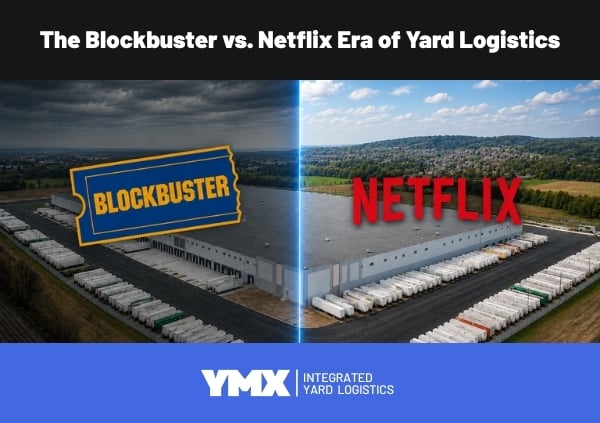
For almost 30 years, Blockbuster dominated the entertainment industry.
It had scale, infrastructure, market share, and brand recognition. At its peak, Blockbuster operated thousands of stores across the world and became synonymous with movie rentals.
Then Netflix changed the model.
Netflix did not win because it operated better retail stores. It won because it recognized that the market itself was changing. Consumer behavior was evolving, operational expectations were shifting, and the future would belong to companies capable of delivering intelligence, convenience, adaptability, and continuous optimization at scale.
That same structural shift is now happening inside supply chain operations, particularly in the yard.
For decades, yard operations were treated as a localized operational function focused primarily on trailer moves, labor coordination, and managing daily activity inside the four fences of a facility. The operating model was largely reactive. Add labor when volume increased. Add equipment when congestion appeared. Solve problems as they surfaced.
That approach may have worked in a slower and more stable supply chain environment. Modern supply chains no longer operate that way.
Today’s enterprise networks are under constant pressure from labor instability, transportation disruptions, tighter delivery windows, rising operating costs, cargo theft, sustainability mandates, warehouse automation dependencies, and growing expectations around real-time visibility and operational synchronization.
As volatility increases across the network, one reality is becoming impossible to ignore: variability eventually converges in the yard.
The yard has evolved from a support function into one of the most operationally sensitive environments in the supply chain. It now directly impacts transportation flow, warehouse productivity, asset utilization, safety performance, throughput, and service reliability across the enterprise.
Yet many yard operations are still being managed with operating models designed for another era.
Legacy Yard Management Providers Were Built for A Different Era
Traditional yard operations providers were built around a transactional outsourcing model.
The focus was straightforward:
- provide labor
- provide yard trucks
- bill hourly
- react to operational disruptions
- manage facilities independently
- rely heavily on manual communication and tribal knowledge
Technology was often introduced as an additional layer rather than as part of a broader operational transformation strategy. In many cases, software simply digitized fragmented workflows without fundamentally improving how the operation functioned.
This created a common pattern across the industry:
- disconnected systems
- inconsistent processes between facilities
- limited operational visibility
- excessive trailer dwell
- gate congestion
- underutilized assets
- reactive decision-making
- difficulty scaling operational improvements across enterprise networks
The issue is not effort. Most yard operations teams work incredibly hard under difficult conditions.
The issue is that the underlying operating model was designed for operational continuity, not continuous optimization.
This is the same mistake Blockbuster made.
Blockbuster continued optimizing physical retail infrastructure while the market shifted toward digital delivery and centralized intelligence. The company focused on improving the existing model while Netflix reimagined the system itself.
That distinction matters because the same shift is now occurring in yard operations.
The Industry Is Moving From Labor-Based Operations to Operational Intelligence
The next generation of yard operations is no longer centered exclusively around labor management.
It is increasingly centered around operational intelligence.
Enterprise shippers are beginning to recognize that isolated yard activities have a direct impact on the broader supply chain ecosystem. Trailer flow affects warehouse throughput. Dock congestion impacts transportation performance. Yard inefficiencies influence detention costs, labor utilization, asset productivity, sustainability initiatives, and customer service levels across the network.
As a result, the industry is shifting away from viewing the yard as a standalone operational function and toward viewing it as an enterprise execution layer that requires synchronization, visibility, standardization, and continuous optimization.
This is where companies like YMX Logistics are helping redefine the category.
Rather than approaching the yard as a labor-centric operation, YMX has built its strategy around what it calls an autonomous Yard Operating System (YOS), an integrated operating framework designed to connect physical execution with digital intelligence across enterprise yard environments.
The model combines:
- operational execution
- embedded yard management technology
- real-time visibility
- predictive analytics
- automated data capture
- standardized operational workflows
- AI-driven intelligence
- sustainability initiatives
- continuous optimization across facilities
The objective is not simply to monitor operations. It is to create a closed-loop operating environment capable of continuously learning, adapting, and optimizing performance over time.
That represents a fundamentally different philosophy from the traditional outsourced yard model.
Technology Alone Will Not Solve the Problem
One of the biggest misconceptions in supply chain modernization is the belief that deploying more software automatically creates operational transformation.
In practice, many organizations end up layering disconnected technologies on top of fragmented operational processes.
The result is often more dashboards, more alerts, more data, and more complexity without materially improving execution.
Technology alone does not stabilize operations.
The organizations creating meaningful operational advantages are the ones aligning technology, operational governance, standardized processes, data intelligence, and execution into a unified operating model.
This is one of the most important lessons from the Netflix transformation.
Netflix did not simply digitize movie rentals. It redesigned the operational architecture behind content distribution, customer experience, and data-driven optimization.
The same principle increasingly applies to yard operations.
The future will not belong to organizations that merely digitize fragmented operations. It will belong to organizations capable of integrating execution, intelligence, automation, and continuous optimization into a unified operational system.
The Future of Yard Operations Will Be Built Around Closed-loop Continuous Optimization
The yard industry is entering a period of structural transformation.
The market is moving:
- from reactive execution to predictive orchestration
- from labor-centric operations to intelligence-driven operations
- from isolated facility management to network-wide optimization
- from manual coordination to autonomous decision support
- from fragmented systems to closed-loop operating environments
This shift is being accelerated by electrification, AI, automation, predictive analytics, and the growing need for enterprise-wide operational synchronization.
The companies that succeed in this environment will not necessarily be the companies with the largest labor footprint or the most equipment. They will be the companies that recognize the operating model itself is changing.
That is the deeper lesson behind the Blockbuster and Netflix analogy. Netflix won because it built a system designed for where the market was going, not where the market had been.
So, the most important question is: Does your yard logistics provider look like Blockbuster in the Era of Netflix?

%20(19).png)