
%20(6)-1.jpg)
In a recent article, the University of Tennessee Haslam College of Business' Global Supply Chain Institute outlined its key takeaways from the Spring 2026 Supply Chain Forum. The article highlighted several themes shaping the future of supply chain management, including artificial intelligence, data readiness, geopolitical uncertainty, procurement transformation, risk management, organizational resilience, and leadership.
Taken together, these insights paint a picture of an industry navigating unprecedented complexity. Supply chains are becoming more interconnected, more dynamic, and more dependent on technology than ever before.
Yet despite significant investments in visibility, analytics, and digital transformation, many organizations continue to face the same fundamental challenge:
Execution.
At YMX, we believe the next competitive advantage in supply chain management will not come from collecting more data. It will come from an organization's ability to transform information into action and strategy into execution.
The University of Tennessee's Key Takeaways
According to the University of Tennessee's analysis, several themes consistently surfaced as priorities for supply chain leaders:
- Artificial intelligence is moving from experimentation to practical application.
- Data readiness remains a critical challenge for organizations pursuing digital transformation.
- Geopolitical uncertainty continues to reshape supply chain strategy.
- Resilience has become a strategic imperative.
- Planning capabilities must evolve to support faster decision-making.
- Procurement is becoming increasingly strategic.
- Risk management requires a more proactive approach.
- Cross-functional collaboration is becoming essential.
- Leadership capabilities are emerging as competitive differentiators.
- Technology investments must be aligned with business outcomes.
While these themes cover a broad range of disciplines, they all point toward a common challenge facing modern supply chains: how to convert increasing amounts of information, technology, and complexity into better operational decisions and stronger business performance.
From Autonomy to Execution
Many of the themes highlighted by the University of Tennessee align closely with a trend we recently explored in our article, From 0 to Autonomy: Redefining Yard Operations for Enterprise Shippers.
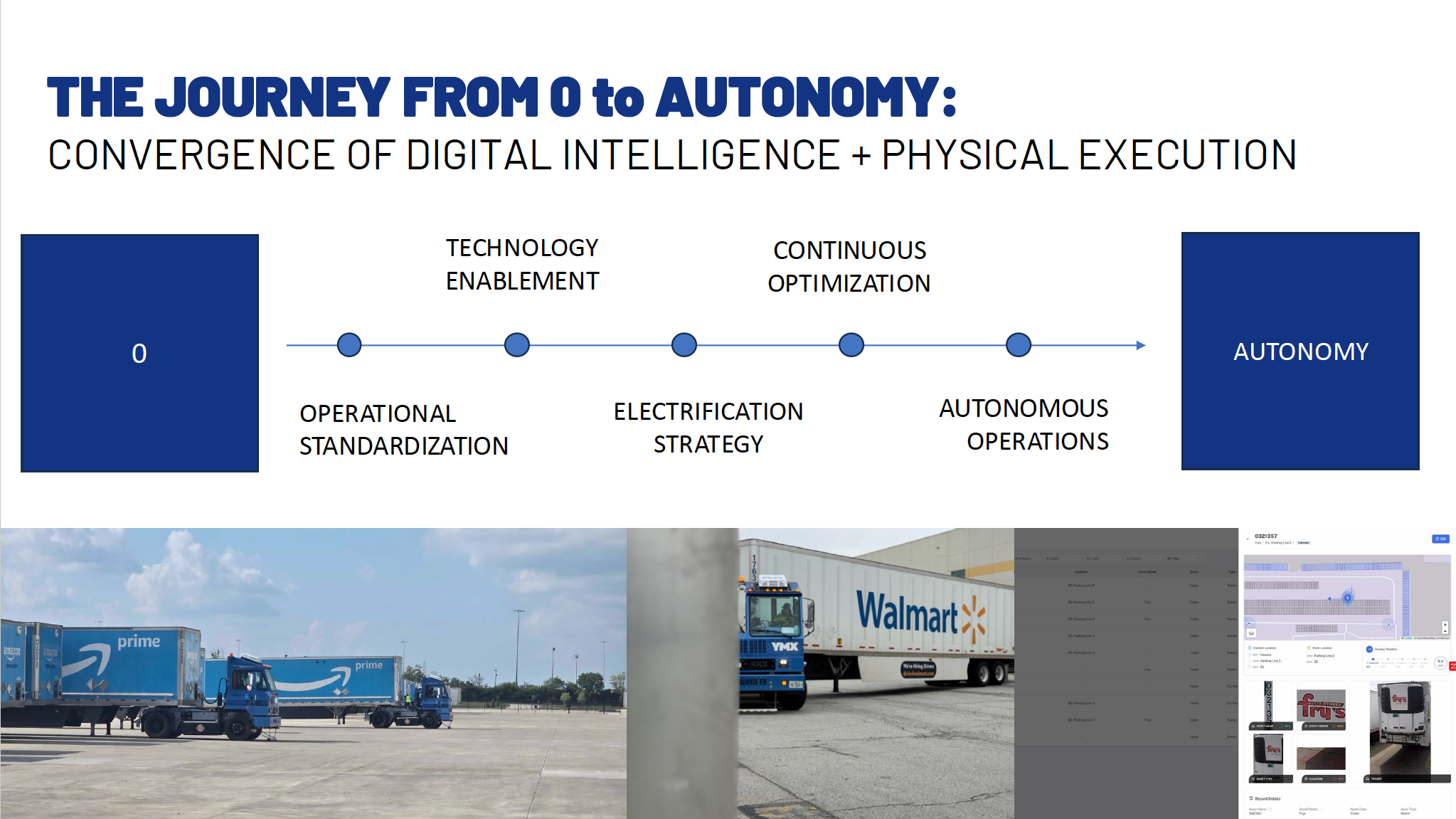
In that article, we argued that autonomy is often misunderstood as a technology initiative when, in reality, it is an operating model. Autonomous operations are not defined solely by autonomous vehicles, artificial intelligence, or automation. They are defined by an organization's ability to continuously coordinate people, processes, technology, and data to make better decisions and execute them consistently at scale.
The same principle applies across the broader supply chain.
Organizations are investing heavily in artificial intelligence, predictive analytics, digital twins, and real-time visibility platforms. These technologies create tremendous opportunities to improve decision-making and operational performance. However, technology alone does not create results. Organizations must still determine how to translate information into action and ensure execution keeps pace with increasing complexity.
This is where YMX believes the next phase of supply chain transformation will occur.
As supply chains become more dynamic, the competitive advantage will not belong to the organizations with the most visibility. It will belong to the organizations that can orchestrate execution across their operations and continuously transform insight into action.
The Era of Constant Disruption
For years, supply chain leaders focused on building visibility. Organizations invested heavily in transportation management systems, warehouse management systems, control towers, real-time tracking platforms, and advanced analytics solutions. These investments delivered tremendous value by helping organizations better understand what was happening across their networks.
Today, most large enterprises have access to more information than ever before.
Yet many continue to struggle with execution.
Global trade patterns continue to evolve. Economic uncertainty remains high. Labor markets remain tight. Customer expectations continue to increase. Regulatory requirements are expanding. The pace of change is accelerating across nearly every industry.
The result is that supply chain leaders are being asked to make more decisions, more quickly, and with greater consequences than ever before.
In this environment, visibility alone is no longer enough.
Why Visibility Does Not Automatically Create Performance
Organizations can identify bottlenecks. They can see congestion. They can monitor inventory levels, transportation flows, labor utilization, and facility performance in near real time.
What remains difficult is determining what actions should be taken next and ensuring the operation can execute those decisions consistently.
This challenge is becoming one of the defining issues in modern supply chain management.
Many organizations have invested heavily in visibility technologies, but fewer have invested in the operational frameworks necessary to transform information into action.
The organizations creating competitive advantage are shifting their focus from visibility to orchestration.
Rather than simply identifying problems, they are building operating models capable of coordinating people, processes, technology, and data to respond in real time.
AI Is Becoming a Decision Engine
Much of the conversation surrounding artificial intelligence focuses on automation. While automation remains important, the larger opportunity may be decision support.
AI has the ability to analyze large amounts of operational data, identify patterns, prioritize actions, predict outcomes, and recommend decisions at a scale that is difficult for human teams to achieve consistently.
In many ways, AI is evolving from an analytical tool into a decision engine.
However, technology alone does not solve operational challenges.
One of the most important lessons emerging from organizations pursuing AI initiatives is that success depends far less on the technology itself than on the operational foundation supporting it.
Artificial intelligence cannot compensate for inconsistent processes, disconnected systems, poor data quality, or unclear workflows.
Organizations that achieve meaningful results are those that first establish disciplined operating models and then apply technology to accelerate performance.
Strategy Succeeds or Fails at the Point of Execution
The same principle applies across every aspect of supply chain management.
A transportation strategy is only as effective as the operation's ability to execute it.
A procurement strategy is only valuable if inventory can flow efficiently through the network.
A forecasting model is only useful if facilities can respond to changing demand conditions.
Strategy succeeds or fails at the point of execution.
This reality is creating a new focus on operational orchestration.
Supply chains are becoming increasingly interconnected. Transportation impacts warehousing. Warehousing impacts inventory availability. Inventory availability impacts customer service. Labor, equipment, facilities, and technology all influence one another in ways that are often difficult to manage through traditional operating models.
As a result, organizations are beginning to move beyond standalone systems and toward integrated operating frameworks that continuously align planning with execution.
Why Yard Operations Have Become a Strategic Operating Environment
Few environments illustrate the challenge of execution more clearly than the yard.
Every supply chain strategy eventually arrives at a loading dock. Transportation plans, inventory plans, procurement strategies, production schedules, and customer commitments all converge in the yard. When execution breaks down there, the effects ripple across the entire network.
The yard serves as the physical connection point between transportation and warehousing. It is where trailers arrive, depart, stage, and move. It is where labor, equipment, inventory, and transportation activity intersect.
Yet despite its importance, it remains one of the least digitized and least optimized environments in many supply chains.
For decades, yards have largely been managed through manual processes, tribal knowledge, and reactive decision-making. While organizations have invested heavily in transportation and warehouse technology, the yard has often been treated as a tactical operation rather than a strategic component of the supply chain.
That is beginning to change.
As organizations pursue greater resilience, efficiency, sustainability, and network-wide visibility, they are increasingly recognizing that operational performance depends on what happens between transportation and warehousing, not just within them.
From Visibility to Autonomous Execution
The next generation of supply chain operating models will move beyond visibility and reporting.
They will combine human expertise, standardized processes, real-time data, predictive analytics, artificial intelligence, and digital twins into a unified framework capable of continuously prioritizing, coordinating, and optimizing execution.
In many ways, the future of supply chain performance will be defined by an organization's ability to build an autonomous operating model that helps teams make better decisions faster and execute them consistently across the network.
This is not about replacing people.
It is about equipping operations with the intelligence needed to navigate increasing complexity, respond to disruption more effectively, and continuously improve performance.
The organizations that succeed will be those that create a seamless connection between strategy, decision-making, and execution.
The Future Belongs to Organizations That Can Execute
The future of supply chain operations will require more than visibility. It will require the ability to orchestrate assets, labor, equipment, workflows, and decisions in real time.
Digital twins, predictive analytics, artificial intelligence, and autonomous operating models will play an important role in that transformation. Not because they replace people, but because they enable organizations to make better decisions and execute them faster.
The conversations and insights emerging from the Spring 2026 Supply Chain Forum reinforce a reality that many industry leaders already recognize.
Technology alone does not create competitive advantage.
Execution does.
The organizations that will lead the next era of supply chain performance will be those that successfully integrate people, processes, technology, and data into a unified operating model that adapts to disruption, makes better decisions, and executes at scale.
The future belongs not to the companies with the most information, but to the companies that can turn information into action.
%20(19).png)